Lila
Lila
Lila is an AI-based application for people with low literacy skills. It guides users along their unique learning paths, providing customized tasks and individualized support to address any questions. These features enhance their learning journey and foster a state of flow.
User Research
Concept
UX Design
Visual Design
Prototyping
Info
Time frame
September 2023 - February 2024
Context
Bachelor Project, Hochschule für Gestaltung
Tools
Figma, Adobe CC
Teammembers
Antonia Gruber, Julia Klotz
Problem
More than 6 million adults in Germany struggle with low literacy. Their reading and writing skills are insufficient for full participation in society.
These people face a wide range of problems, from exclusion from day-to-day information to limitations in social and professional aspects of their lives. The biggest challenge, however, is the stigma they face. Although it affects one in eight people in Germany, people with low literacy skills often feel ashamed of their situation, making it very difficult for them to open up and seek help.
Research
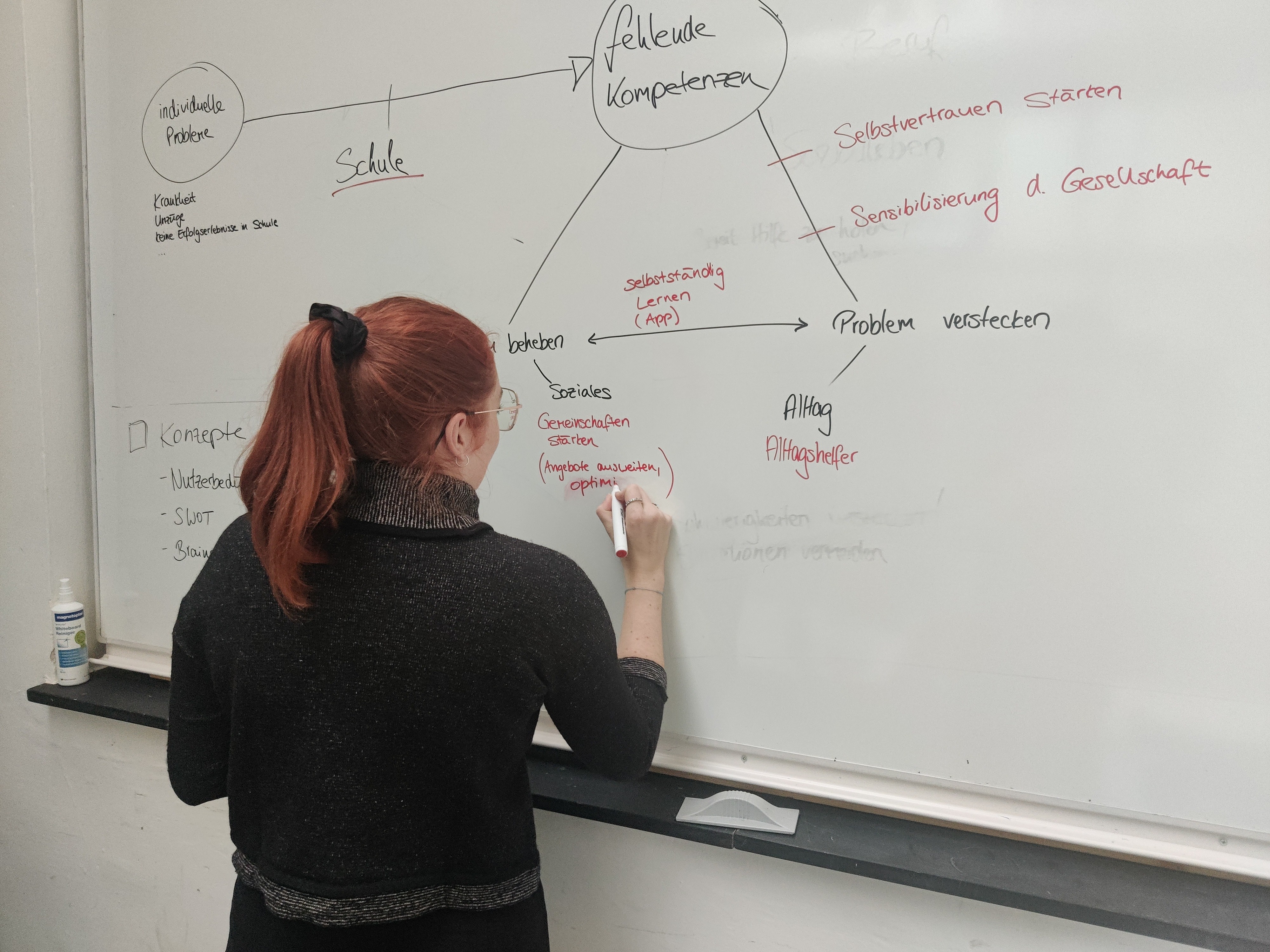
To gain a detailed insight into the topic, we conducted extensive desk research, performed benchmarking, and held interviews with experts and affected individuals. Finding these individuals was challenging, as they often keep their struggles hidden and feel ashamed to discuss the issue. Fortunately, we managed to connect with several affected persons who provided us with valuable insights and supported us throughout the process by being available for questions and participating in user testing. This allowed us to gain a deeper understanding of the causes and consequences of illiteracy.
problems of
the affected
Everyday Life
Everyday tasks like grocery shopping and the use of public transport become a hurdle
Career
Dependent on jobs that require little literacy, also they are afraid of being exposed
Social Life
They have few friends becaus they struggel to open up, yet they are dependent on trusted persons
Shame, the fear of being judged and the feeling of being alone with it lead to a lack of self-confidence.
Despite the severe limitations, only a few manage to improve their situation.
With this project we want to adress the problem at its root and make it easier for individuals to improve their literacy skills. Therefore we identified two pain points that people currently face when trying to learn it
Pain Points
01
Lack of Motivation
In order to increase literacy as an adult, the affected have to be consistent over a long period of time. They also think, that they cant learn it anymore, because of negative experience related to learning in the past
02
They are scared to come out
Opening up increases the probability to sucess, but the affected are very shy to open up about their weakness because of shame
To find a solution that addresses the pain points, we conducted several mini-sprints focusing on our concept ideas. For each concept, we created a user journey, formulated "how might we" questions, and performed a competitor analysis. We also ideated on feature ideas and used sketches, card sorting, and the MoSCoW method to gain a better understanding of the concept.
Concept
The Lila learning app aims to make it easier for individuals to improve their literacy skills. The main features are specifically designed to lower the barriers in the current learning process and address the existing pain points.
Independent Learning
The app enables flexible and independent learning, users do not have to open up to others, but can simply work on their weaknesses on their own from anywhere and at any time. Yet they are not entirely on their own, as an AI assistant accompanies and supports them throughout their learning journey.
Intrinsic Motivation
Flow Experience
Accesability
Final Screens
Onboarding
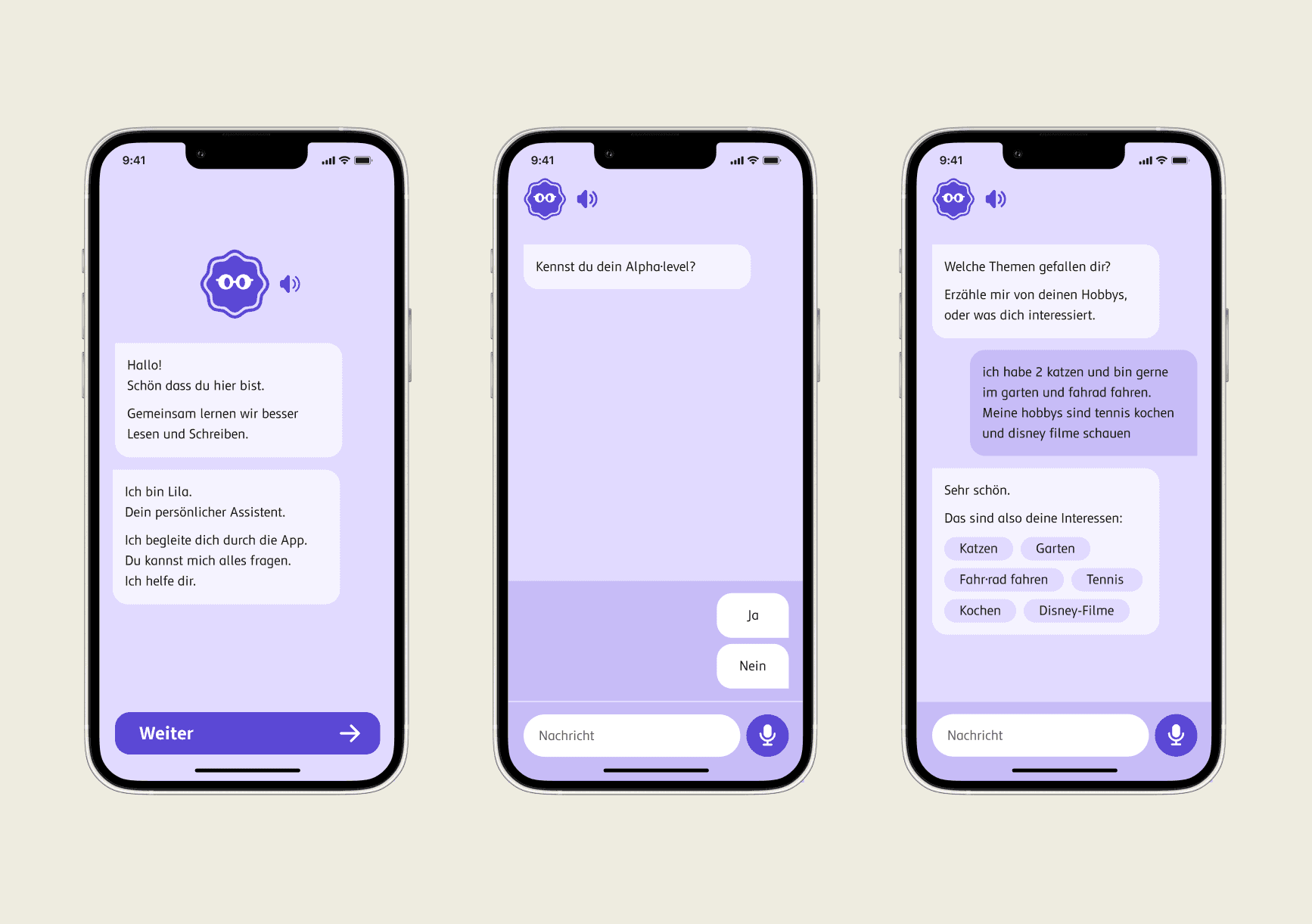
A personalised onboarding process, guided by an AI assistant in a chat dialogue, facilitates the first steps. The assistant explains the app's features and gathers information about the user's skills and preferences to deliver personalised content.
Exercises
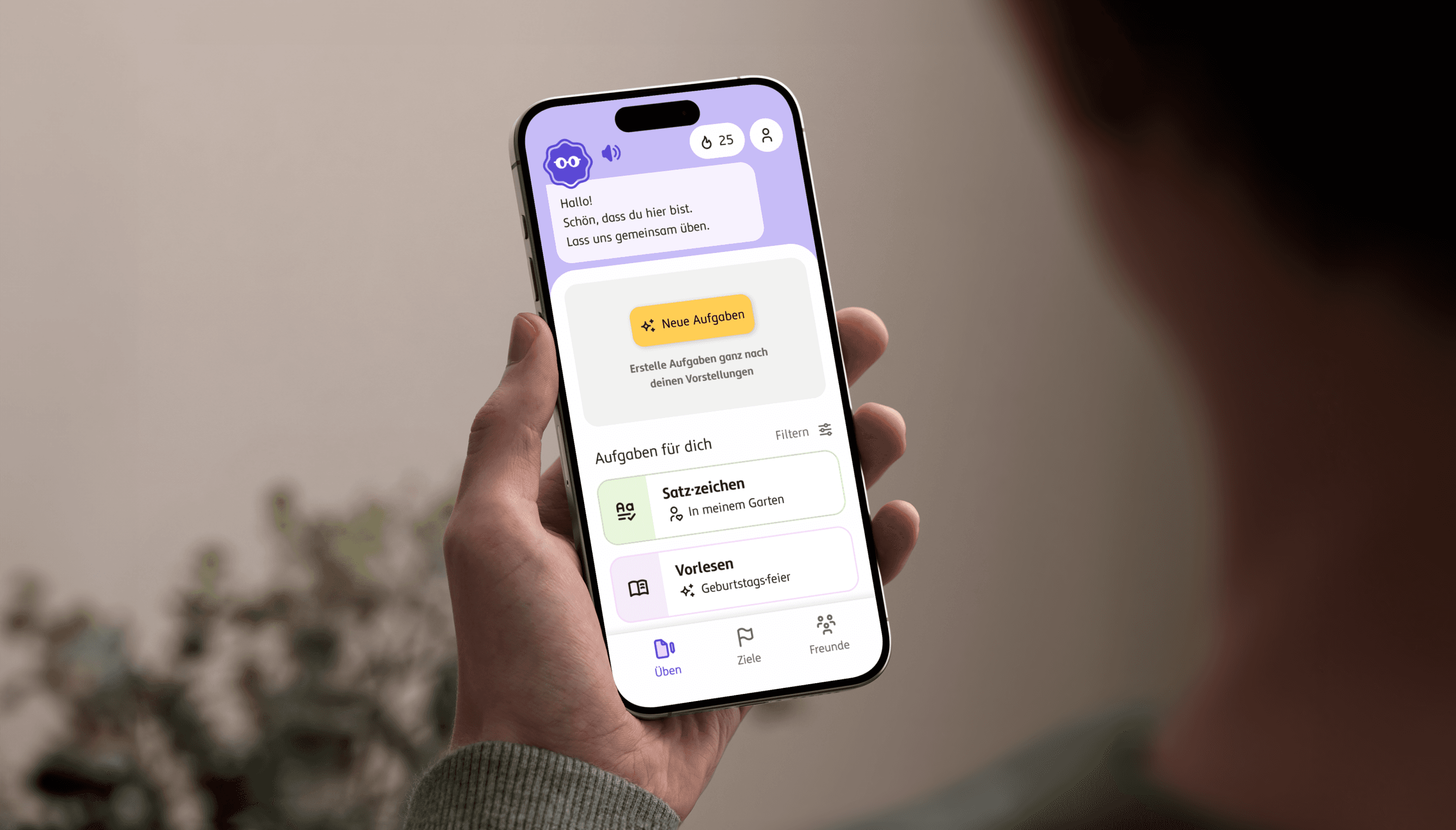
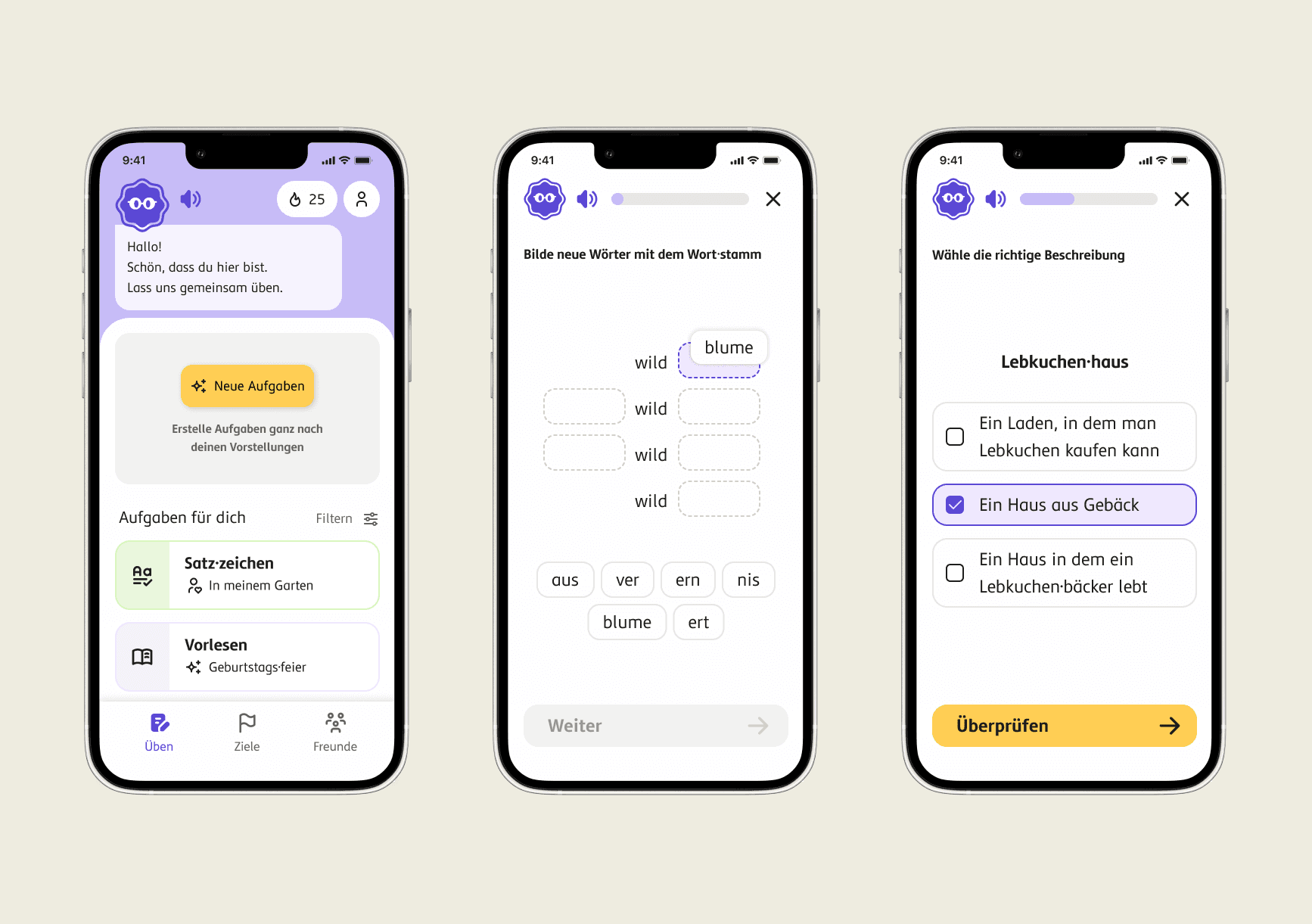
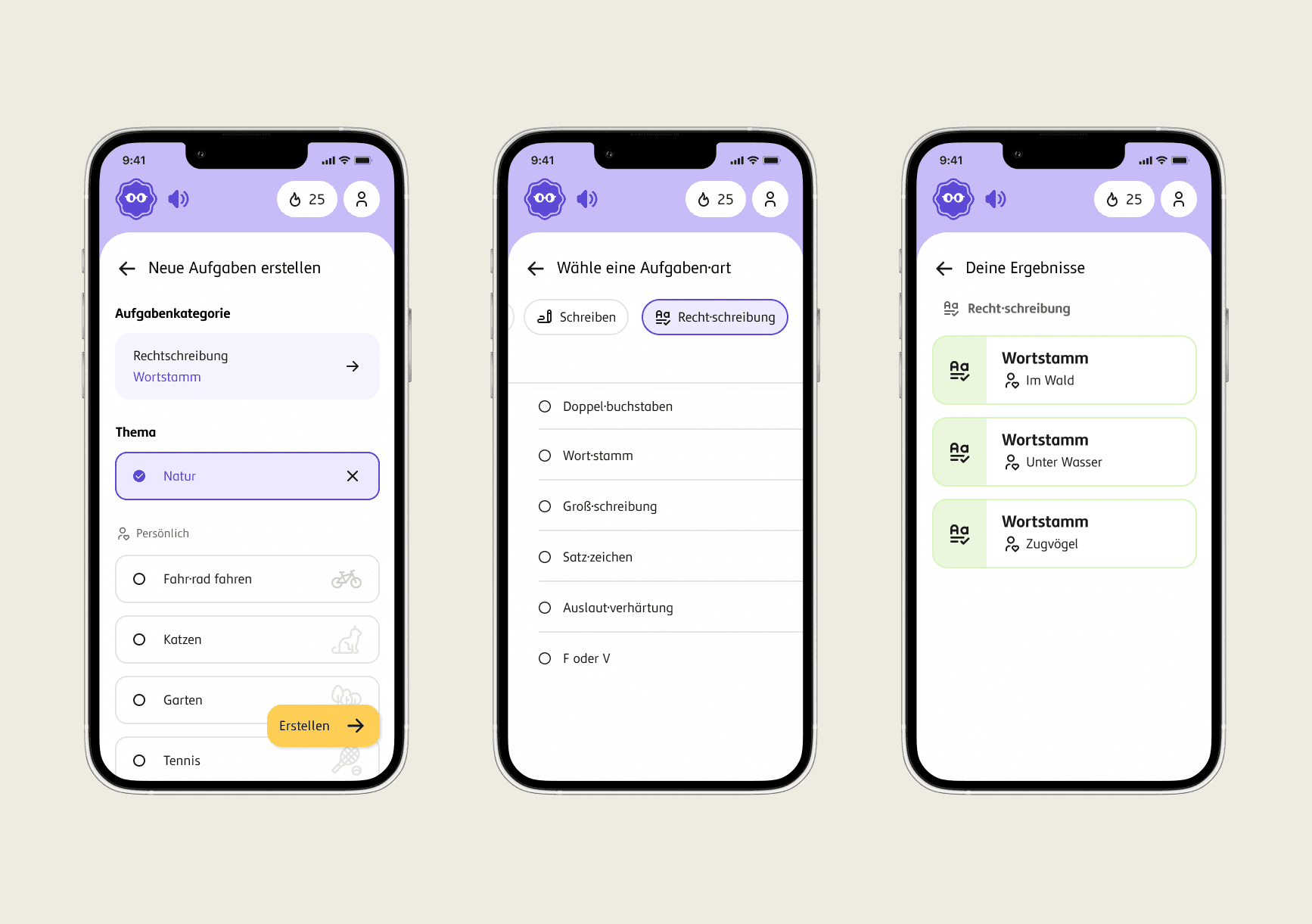
The AI generates personalised task suggestions based on the user's individual needs and interests. These recommendations can be found on the start page of the app and are labelled with the corresponding task category and topic. They enable a quick start to the exercise and take into account the relevance for the current learning process. The suggestions continuously adapt to the user's ability and preferences. Filter options allow for quick selection, and ongoing customisation provides a flexible learning environment that meets individual needs.
Generate tasks
Set goals
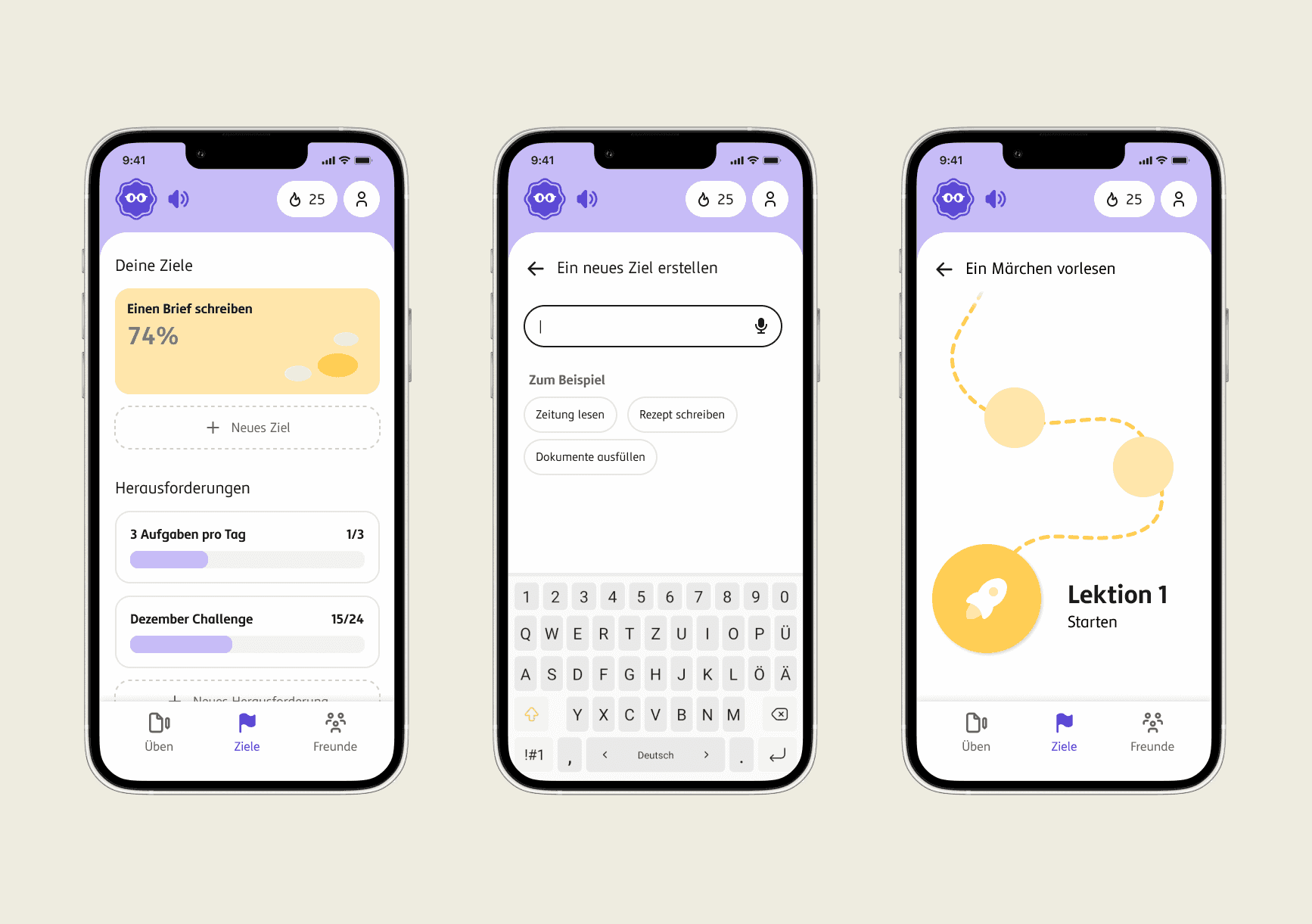
Users can set learning goals, such as writing an application or reading a story. The AI creates personalised learning paths with multiple lessons to achieve the goal. Progress is shown visually and as a percentage for goals not yet completed. Goals can be adjusted or deleted at any time and completed goals are saved in the profile.